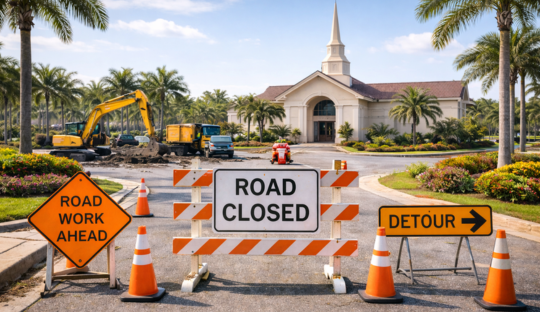
When a government entity targets church property for a road expansion, utility project, school, or any other public use, the process can feel overwhelming. Churches are unique. They aren’t just buildings—they are sacred spaces, community hubs, schools, food pantries, counseling centers, and, often, the financial heart of an entire congregation. Losing part—or all—of that property can disrupt ministries, attendance, revenue, and the fabric of the community itself.
Florida’s eminent domain laws give churches strong rights. But protecting those rights and ensuring full compensation requires a strategic, experienced approach. Here’s what every church leader needs to know.
-p-2000.png)
.svg)
Unlike regular commercial properties, churches face unique types of losses when land is taken. Florida law allows recovery of “full compensation”, which often includes more than just the value of the land taken.
The key categories usually include:
This includes the market value of the portion taken and any improvements affected—sanctuaries, classrooms, parking lots, signage, utilities, and more.
If the government only takes part of your church property, the remaining portion may lose value.
For example:
• Losing parking spaces
• Losing visibility from the main road
• Losing access or traffic flow
• Impairing future expansion plans
Florida law requires the government to pay for this drop in value.
Sometimes, the law allows recovery of the money needed to fix the damage caused by the taking.
That might include:
• Reconfiguring parking
• Building new access points
• Relocating utilities
• Sound or privacy buffers
• Drainage or stormwater redesign
These costs must be reasonable and necessary—and supported with expert evidence.
If the project forces the church to relocate ministries, move buildings, or temporarily shut down, those costs may also be compensable.
Government offers are typically made early—and often before the full effect on the church is understood. In almost every church case, the initial offer leaves out major categories of compensation, such as:
• Loss of parking
• Loss of access
• Reduced capacity for events and services
• Noise, traffic, or visibility impacts
• Loss of future expansion plans
• Impacts on daycare, school, or community programs
• ADA impacts
Once engineers, planners, appraisers, and accountants analyze the full picture, the true value of the claim almost always increases significantly.
Historic or Special-Use Structures
Sanctuaries aren’t comparable to ordinary buildings. Internal finishes, stained glass, steeples, sound systems, and design choices carry unique value.
Zoning Constraints
Many churches sit on land where current zoning would not allow the church to be rebuilt today. This dramatically increases fair compensation.
Congregation Flow & Ministry Operations
If the taking disrupts safety, parking, access, or traffic flow, it can reduce attendance—directly affecting the church’s functioning and finances.
School and Childcare Programs
State and local regulations may require specific acreage, ingress/egress requirements, playground buffers, or parking. A taking may violate those requirements, leading to massive operational impacts.
These issues must be documented and supported with expert testimony. Without that, the government will ignore them.
We bring in appraisers, engineers, planners, traffic experts, and regulatory consultants immediately. Early analysis prevents costly mistakes and strengthens the claim.
Churches often grow over time. If a taking eliminates future possibilities, that loss must be valued and claimed.
We analyze:
• Parking ratios
• Fire code requirements
• School or daycare licensing impacts
• Lost ministry capacity
• Traffic flow and ingress/egress safety
• Utility relocation costs
This documentation is critical to maximizing recovery.
Government appraisals almost always undervalue religious properties because:
• They don’t understand church-specific usage
• They ignore operational disruptions
• They underestimate severance damages
• They assume minimal cost-to-cure exposure
We expose these flaws and build a stronger, evidence-based valuation.
How My Firm Is Compensated
In Florida eminent domain cases, the government pays your attorney’s fees and costs, not the church.
That means:
• Your compensation is never reduced to pay attorney fees.
• You pay nothing out of pocket for our work.
This structure exists because the Constitution requires full compensation—and the government must pay enough to ensure property owners can hire qualified counsel without financial burden.
⸻
Why Experienced Counsel Matters—Especially for Churches
Church eminent domain cases are not routine. They require a blend of:
• Deep eminent domain knowledge
• Real trial experience
• Understanding of land use, zoning, and church operations
• The ability to coordinate a multidisciplinary team of experts
• The willingness and skill to take the case to trial if needed
Courts in Florida have repeatedly recognized the importance of highly skilled counsel in complex property and damages cases. Judges have noted the exceptional skill, efficiency, and trial experience brought to these matters, describing the litigation results as “exceptional” and “frankly amazing.”
That level of precision and preparation is exactly what churches need when the government comes for their property.
⸻
Every Church Deserves Full Compensation. We Make Sure That Happens.
A taking can threaten the future of a church community—physically, financially, and spiritually. My job is simple: protect your rights, preserve your mission, and make sure the government pays every dollar the law requires.
If your church has received a notice of taking—or even hears rumors of a future project—reach out immediately. Early action makes a tremendous difference.


.svg)